Powering reliability: The art and science of Vegetation Management
Keeping electricity flowing to homes and businesses is a complex undertaking, involving a myriad of systems, technology, equipment and people. Line workers—the men and women out in the field installing and repairing power lines, poles, transformers and the like, often during and after storms—are certainly one of the most visible (and critical) aspects of this. But so too is another role: vegetation management.
Far more than just tree trimming, the specialized field of vegetation management plays a pivotal role in maintaining safety, reliability, and resilience across utility systems.
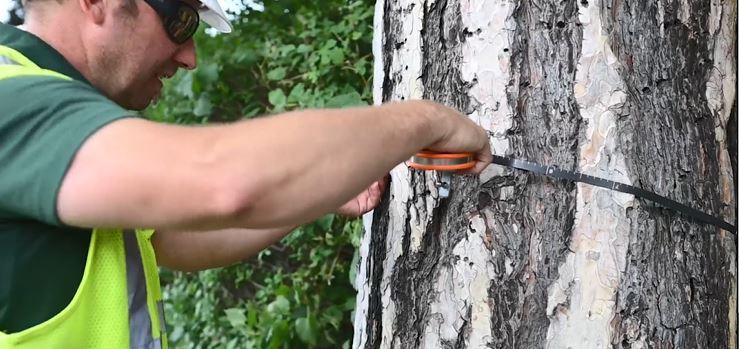
Vegetation management refers to the practice of controlling tree growth and other vegetation near electric utility infrastructure. Kyle Duck, Director of Projects at Rochester Gas & Electric, sums it up simply: “It’s managing the growth of trees and vegetation around electric utilities infrastructure to ensure safety and reliability.”
Avangrid’s family of electric utilities—NYSEG and RG&E in New York, Central Maine Power (CMP) in Maine and United Illuminating (UI) in Connecticut, employ comprehensive programs to address vegetation’s impact on power delivery. These programs span danger tree removal, reclamation of overgrown circuits, and ongoing maintenance—each tailored to specific needs and timelines. For example, danger trees are identified outside the right-of-way that pose a high risk of falling into lines and are removed entirely. Meanwhile, reclamation efforts restore areas with significant vegetation overgrowth, creating safer, more efficient corridors.
 Erin Perry, former manager of Vegetation Management at NYSEG, and now an Operations Manager there, explains the sophistication behind these efforts. “We rely on a prioritization tool that combines field data, outage records, and analytics to strategically address problem areas. It’s about using data to guide our actions.”
The Scope and Community Impact
In practical terms, vegetation management involves miles of trimming and tree removal. In New York, NYSEG and RG&E collectively prune more than 12,000 trees and remove approximately 10,000 danger trees annually. UI’s Enhanced Vegetation Management Program extends its protection zone eight feet from conductors, systematically maintaining circuits to ensure reliability. In Maine, the most heavily forested state in the country, CMP manages approximately 3,700 miles of distribution maintenance, 180 miles of enhanced tree trimming, 9,000 acres of transmission area, and thousands of various tree removals as a part of their day to day operations, says Katie Manende, Manager of Vegetation Management at CMP.
“My group is comprised of 12 distribution and transmission arborists who show up every day for their co-workers and our customers,” Manende says. “They take pride in their jobs, and many of them have been in their respective divisions for over a decade. We are responsible for the vegetation management planning and execution for all of the company’s service territory.”
“We’re not just working on a few trees here and there. Across NYSEG and RG&E, we’re managing over 4,800 miles of lines each year,” says Perry. This scope underscores the significant resources—both human and financial—required to keep systems operational. Kyle Kleza, Manager of Vegetation Management at UI, and a team of 120 contractors and arborists work daily to implement its program.
Community engagement is a cornerstone of successful vegetation management. Programs like the Arbor Day Foundation’s “Right Tree, Right Place” initiative help to educate homeowners about planting practices that minimize future conflicts with utility lines. Utilities also collaborate with local schools, soil and water districts, and municipalities to plant appropriate species and raise awareness.
 “It’s about building a partnership,” adds Kleza. “In Connecticut, customer consent is required for most tree work. We balance maintaining the tree canopy with ensuring reliability.”
Manende concurs: “It’s true that a lot of time goes into planning and executing the tree work, but another big piece of what we do is customer engagement,” she says. “For a large majority of the work we do, we need permission from private property owners and it’s important to explain to them the process and why we are doing the work we are doing.”
Another significant challenge is managing invasive species, such as the Emerald Ash Borer, which devastates ash trees. The danger tree program identifies and mitigates risks from these threats, combining proactive removal with ongoing monitoring.
Behind the Work: The Human Element
For the professionals in vegetation management, the work is deeply rewarding. Perry, who began her career as a forestry major, reflects on the journey: “It’s about using what I know to improve customers’ lives. From ensuring visual and physical access for line workers to enhancing reliability, the impact is tangible.”
Manende studied at the University of Maine at Orono, and has a B.S. in Forestry, a B.S. Wildlife Ecology, and a Masters of Forestry. “I always had a passion for the outdoors and discovered I could make a career out of it. The most challenging, but what can be the most fun, are the constant variables that pop up that make me and the team re-evaluate how we plan and execute our work on a daily basis. By far most satisfying is the reliability benefit we know we are providing to our customers.”
Duck shares a similar sentiment, emphasizing the collaborative nature of the work: “The people in this industry are extraordinary. When storms hit, everyone—from arborists to line workers—come together. It’s a passion we all share to ensure our customers have power. Electricity has become indispensable in modern life. From charging cars to streaming entertainment, customers expect seamless service.”
Customers also play an active role in supporting these efforts. Utilities encourage a “see something, say something” approach, urging residents to report leaning trees or potential hazards. This partnership between utilities and communities ensures quicker response times and heightened awareness.
At its core, vegetation management is about delivering safe and reliable power to communities. Perry puts it succinctly: “We’re not providing a free arborist service. What we do is about keeping the lights on.”
Kleza adds, “The professionalism of the teams involved cannot be overstated. From data-driven planning to careful execution, it’s a dedicated effort by highly-skilled individuals.”
The importance of vegetation management cannot be overstated. On a calm day, tree-related issues account for 30 percent of power outages. During major storms, that number skyrockets to 90 percent. “Our work is critical for safety, reliability, and resilience,” Kleza emphasizes.
Thanks to thoughtful planning, strong community partnerships and tireless dedication, Avangrid’s Vegetation Management teams ensure that customers can count on the power they need—rain or shine.